The Fantasy of Home Movies. Emigrant Films at Home (zuhause)
This dissertation project addresses a hitherto little-studied phenomenon within private filmmaking: the fantasies that accompany the films themselves and the objects surrounding them—or situated within their field of view. The study posits that the family film—as a vehicle for the longing associated with success stories involving transatlantic migration—lays an imaginary (and distinctly colonial) claim to ownership through the exoticization of its motifs; in doing so, the film’s tendency toward exaggeration lays bare its own underlying structure.
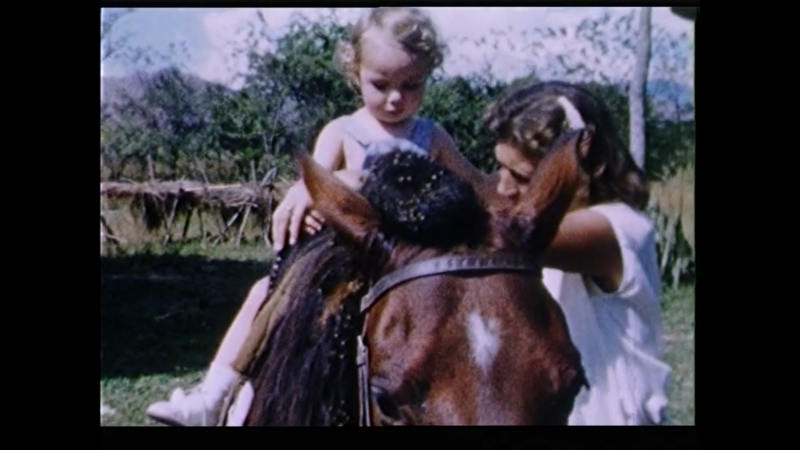
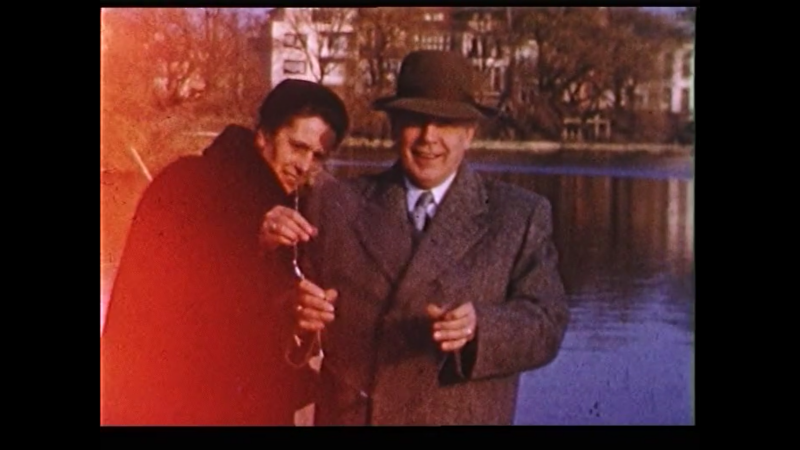
The project aims to capture these fantasies by examining family films that circulated across the Atlantic—documenting a Hamburg family’s emigration to Venezuela between 1951 and the 1970s. At its core, the material comprises a private collection centered on demonstrating newfound mobility and the experience of distant lands. There is nothing unusual about the imagery in these 8mm and Super 8 films: we see celebrations, views from a ship’s deck, or a scene on a traffic island in Caracas. Things become compelling, however, when one considers the highly exaggerated framing of these films within their two screening locations—the domestic spaces of the family (Hamburg and “Hamburg-Caracas”).
I have the opportunity to grasp this framing because it constitutes part of my own imaginary possession. The very fact that I have made this collection the subject of my dissertation demonstrates that I am, in turn, “possessed” by it (Johnson 2011). The family of the merchant who shot the footage is my own; at the start of my project, their house—and its original furnishings—was still largely intact. I am particularly interested in the way these images—spanning both private and public realms—spill over and proliferate.
The act of setting out is repeated among those who remained behind. The Hamburg apartment where the films ended up is oriented toward sharing in that distant world and staging the family’s own mobility. The act of handling images that have made a transatlantic journey becomes, through repetition, a feverish reassurance that one is also in motion and participating in the experience.
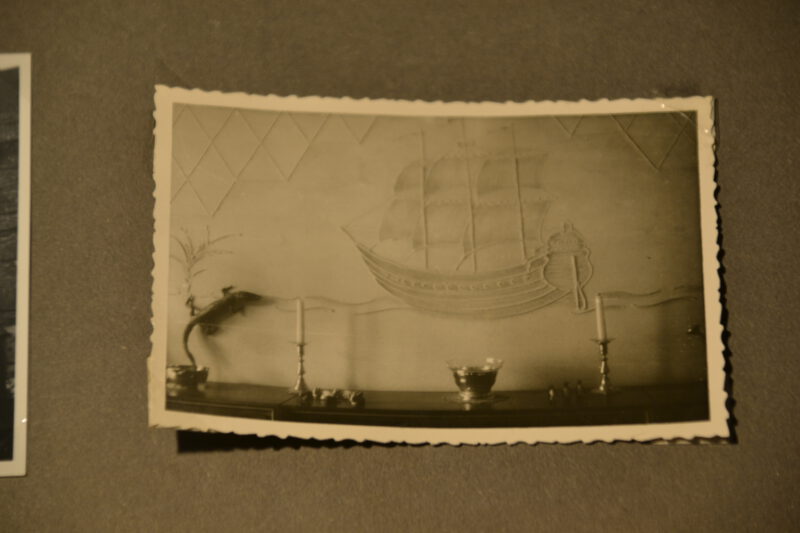
My project takes as its starting point this collection of emblematic images and ideas that constitutes the visual archive and the small world of my own family. This gives me access both to the visual output of a Hamburg merchant family and to the specific location—and its furnishings—where these films are screened. It becomes evident here that the films are not merely a record of private daily life; rather, the everyday existence surrounding these films becomes paradigmatic precisely because of the unusually excessive way the space was remodeled to accommodate them.
How did images from the Caribbean find their way into a German living room? What, in this context, actually constitutes the “holiday film”? Where is the film? In this instance, it is found in suitcases, plastic bags, a closet, and—at the moment—in a desk in Frankfurt am Main.
Profile

Katharina Jost is a research assistant in the graduate program “Configurations of Film” and a doctoral student at Goethe University Frankfurt am Main. She studied Theatre-, Film- and Media, as well as Art History, at the universities of Frankfurt am Main and Vienna. Since 2013, she has been a freelancer at the DFF (Deutsches Filminstitut & Filmmuseum). There, she wrote texts for an online exhibition and presented objects from the collection in podcasts. She also analyzed oriental motifs on a collection of the house’s magic lantern slides. She has published in art historical and film studies contexts. For the research program, she organized the Klausurtagung at Kloster Eberbach (2025) and the international conference “Moving Image Remains” (2026) and is co-editor of the publication under the same name (in preparation). Outside of her academic career, she participates in artistic projects, organizes concerts, and plays and sings in a band. Her research topics include projections, living rooms, home movies, amateur film, and (virtual) travel.